
Jan Madeus · Berlin
Das Haus gegenüber
One apartment block, seen from the same window over years. Only the light changes — and everything that makes the building look lived in has been taken out.
The Building Opposite
I have seen half the world with a camera. The series that matters most to me was made from my third-floor window.
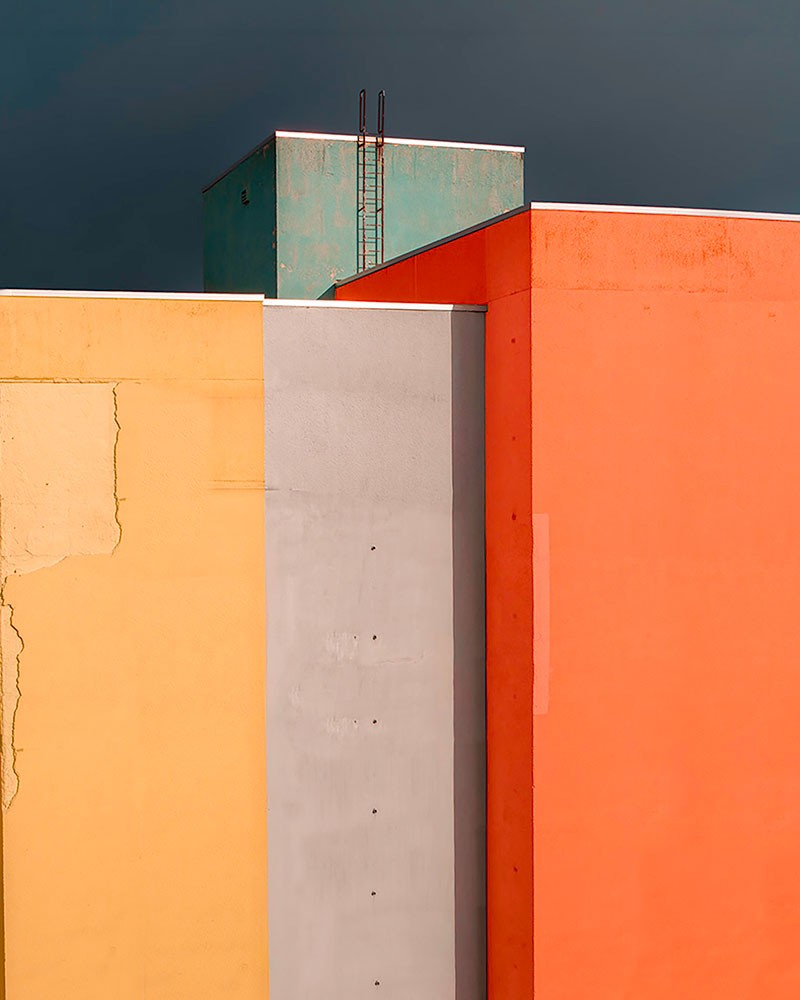
There is an apartment block across the street. A parapet, a ladder, a green box on the roof. Every time I came back from sea it was unchanged — the same roof, the same ladder. At some point I started photographing it. Always from that window, never from anywhere else. Only the light was different each day.
In post-production I remove what makes the building look inhabited: windows, balconies, laundry, satellite dishes. The house stays inhabited — in the picture it is empty. The removal is not a correction. It is the work. I shift the colours until the building can no longer be identified.
Sometimes two doves sit on the ladder. Those I leave. They make the emptiness larger, not smaller.
The rule
I photograph an apartment block in Berlin-Kreuzberg that stands opposite my flat.
I photograph it from the third floor, through the same window — from no other position, and not from the street. What changes is the light; I wait for it rather than look for it.
From every picture I remove the traces of the people who live there: windows, balconies, laundry, satellite dishes. The house stays inhabited — in the picture it is empty. The removal is not a correction. It is the work.
What the house does to itself is not removed: cracks, repairs, discolouration, the dirt on the render. The birds are not removed.
The series runs for as long as I live in this flat.
What is Das Haus gegenüber?
Das Haus gegenüber (German for “the building opposite”) is a fine-art photography series by the Berlin artist Jan Madeus. A single post-war apartment block in Berlin-Kreuzberg is photographed from one fixed window across the street, across many years and many states of light.
Two operations define the series. The colour is shifted into a muted register of ochre, slate blue and weathered green. And every trace of habitation — windows, balconies, laundry, satellite dishes — is removed in post-production, leaving a depopulated surface. Where the artist’s series Fremde Fassaden moves across many buildings, this one stays with a single one and lets time do the work. Occasional birds are kept; they sharpen the emptiness rather than relieve it. The later series Auf Augenhöhe turns the same question around: there nothing is removed and the colour is left exactly as found.
About this series
The series is not closed: one building, one vantage point, one decision applied consistently. It runs for as long as the artist lives in the flat opposite. What varies is light and weather; what stays fixed is the window and the removal. Read together, the images work less as views of a house than as one surface passing through a year.
A booklet of the series is available as a PDF. It goes out to First Viewings, the small mailing list that sees new work before it appears anywhere else.
Get the booklet — join First Viewings