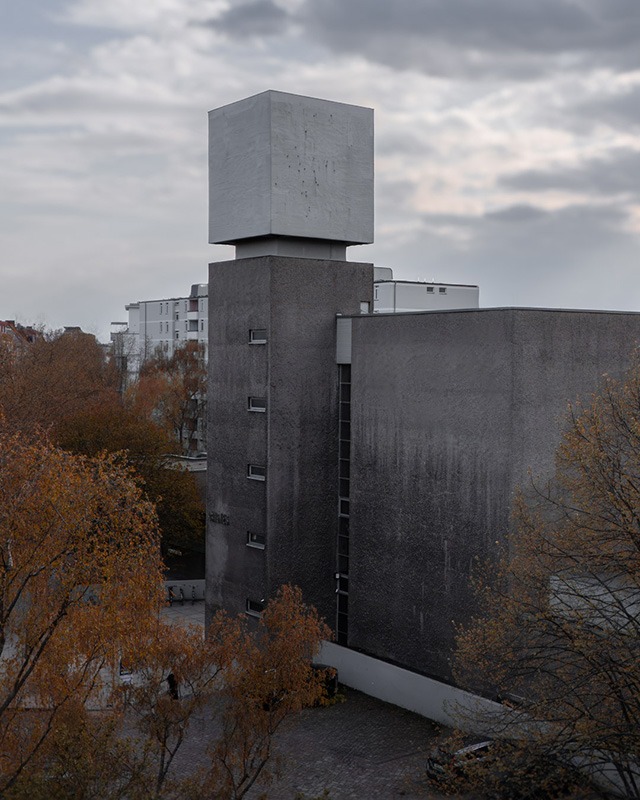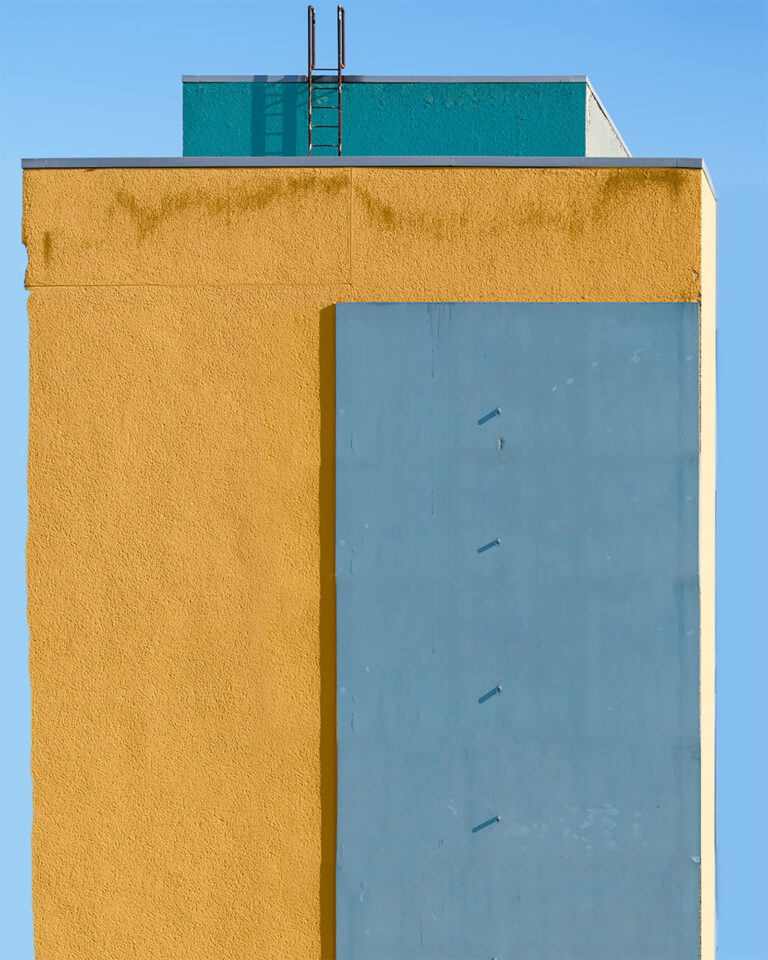
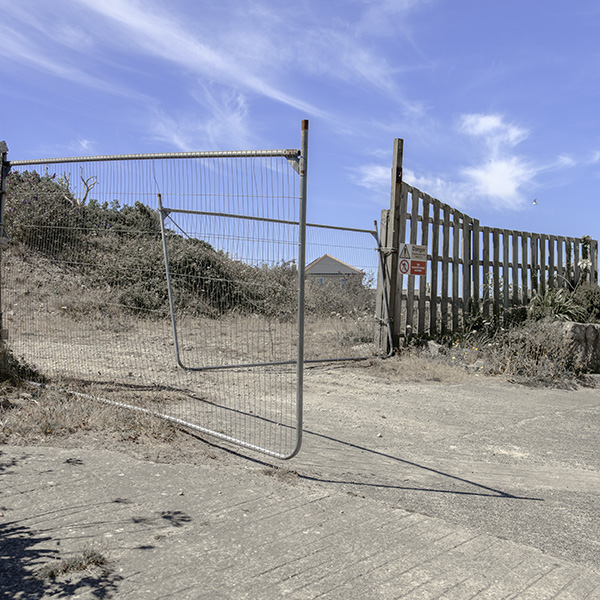
I studied painting before I ever earned money with a camera. For years that looked like a detour. It turned out to be the reason my photographs are built the way they are — colour against colour, weight against emptiness, the frame as a decision rather than a find. This is a note on the road from painting to photography — what stayed, and the slower business of unlearning the people I admired.
What painting leaves behind
Painting teaches one thing photography tries hard to make you forget: a picture is built, not found. A painter never believes the canvas simply happened. So when I stand in front of a façade, I do not see a building with a history and a function — first I see a surface someone has already primed: fields of colour, a rhythm of openings, a weight distribution that either holds or doesn’t. The photographers I feel closest to worked the same way. Saul Leiter let the everyday slide into painterly abstraction through glass and colour; it is no accident he trained as a painter too.
Imitation, then subtraction
For years I photographed like the people I admired, and I do not regret a single borrowed picture. Imitation is not the enemy of style — it is the instrument that finds it. You copy honestly, for long enough, and then you subtract: everything that belonged to someone else falls away, and what refuses to leave is yours. In my case what refused to leave was small and stubborn — flat surfaces over grand views, colour over drama, the same subject again rather than a new one.
One building changed the direction of the subtraction. Standing in front of Frank Gehry’s Guggenheim in Bilbao, I understood that architecture could be treated as sculpture — not documented but interpreted. I did not want to photograph what the building looked like. I wanted to photograph what it was doing. That permission never expired, and it has very little to do with famous buildings: the housing block across my street is doing something too, if you watch it long enough.
Seeing as a choice
John Berger said that we only see what we look at, and that looking is an act of choice. Style, I think, is what those choices look like after they have narrowed. Mine narrowed to façades, surfaces and slow transformations — to a handful of series that circle the same questions, and to the habit of returning: the whole of Das Haus gegenüber exists because I kept looking at one building instead of finding new ones.
You do not need exotic places. You need attention — and the confidence that your point of view, however quiet, has a validity of its own. The rest is subtraction.