The brutalist buildings in Berlin fall into two groups: a handful of icons that everyone photographs, and the everyday concrete that almost nobody does. This guide covers both — Mäusebunker, St. Agnes, Bierpinsel, ICC, the Czech Embassy, the Urban hospital, and the unlisted estates in between — with a working photographer’s notes on where each one stands and what kind of light it asks for. For the argument behind these notes, the essay Brutalism, Seen from the Street is the other half of this page.
Mäusebunker — Lichterfelde
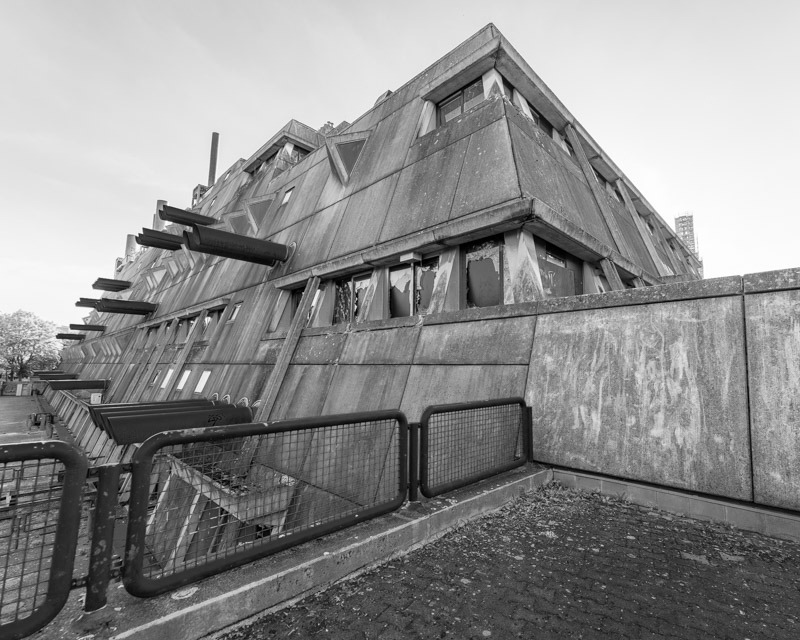
Gerd and Magdalena Hänska’s former research building is Berlin’s brutalist celebrity: a grey wedge with blue ventilation pipes aimed at the street, argued over for years and finally listed as a monument in 2023. It photographs like what it is — a ship run aground. Go for hard side light that draws the concrete ribs, and take the pipes seriously: they are the loudest blue in the district. I keep a German field note on the Mäusebunker on my architecture site; the two photographs here are from that visit.
St. Agnes — Kreuzberg
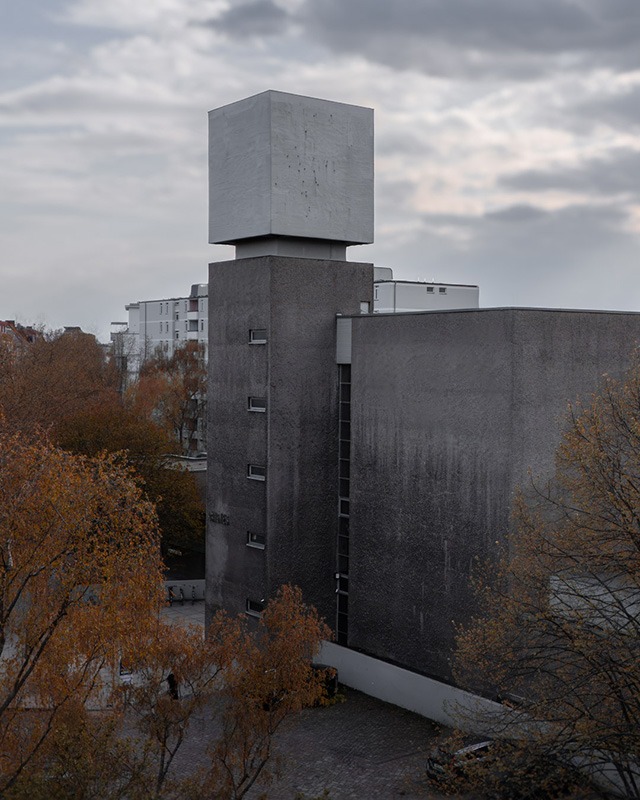
Werner Düttmann’s church from 1967, deconsecrated and, since 2015, home of the König Galerie. From the street it is a windowless block that answers only to weather; inside, during gallery hours, it is mass, stillness and indirect light. Photograph the tower against an overcast sky and the concrete turns into a flat plane — the closest a building gets to a painted field.
Bierpinsel — Steglitz
Ralf Schüler and Ursula Schüler-Witte’s tower from 1976 stands on legs above the Schloßstraße traffic like a poured sculpture. It is Brutalism at its least serious — pop-coloured over the years, argued about ever since — and it photographs best from below, where the underside shows how strange the structure really is.
ICC — Charlottenburg
The same architects’ congress centre, opened in 1979, is strictly speaking Brutalism’s high-tech cousin — aluminium skin rather than raw concrete. I include it for the mass: it reads as a machine moored in the city, longer than anything around it, and in low sun the ribbed flanks behave exactly like concrete in a photograph. Distance is the tool here; the building only becomes legible from across the motorway.
Czech Embassy — Wilhelmstraße, Mitte
Built for the Czechoslovak state in the seventies by Vera and Vladimír Machonin, the embassy hovers over Wilhelmstraße as a dark, glazed slab on concrete supports — East-Modern luxury rather than social housing. It is the most photogenic corner in a street of government boxes, and the one building on this list that looks better in flat grey light, when the glass stops reflecting and the mass takes over.
Krankenhaus am Urban — Kreuzberg
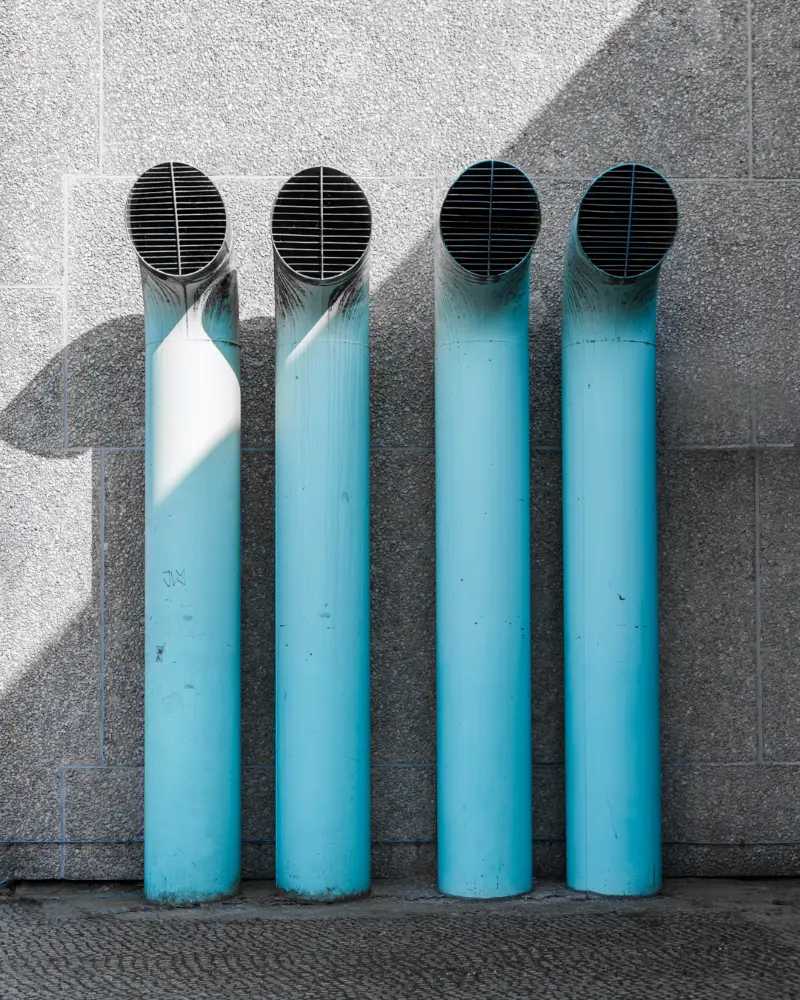
Peter Poelzig’s hospital complex, inaugurated in 1970 as post-war Berlin’s first new municipal hospital, is where the icons end and my own subject begins. Nobody travels for it. But a run of turquoise ventilation pipes against its grey wall became one of the pictures in Fremde Fassaden — proof that the unlisted concrete offers more than the famous kind, if you stand in front of it long enough.
The unlisted estates — Kreuzberg and Mitte
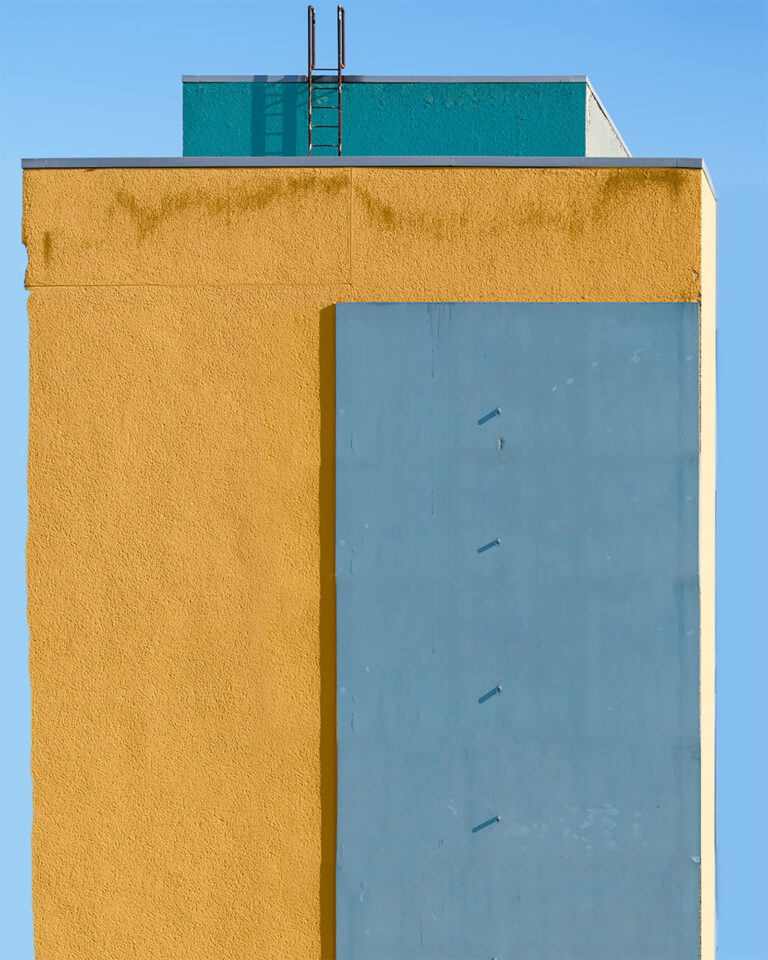
The seventh entry is not one building. Post-war housing blocks, school wings, the backs of institutions — architecture that never learned to pose and therefore never lies. This is where most of my series was made, within walking distance of my flat: the walls of Kreuzberg and Berlin-Mitte in Fremde Fassaden are all of this kind. If you photograph only the icons, you photograph what everyone already knows Berlin looks like.
Light, standpoint, permission
Three practical notes. Light: low sun rakes across ribbed concrete and draws its relief; an overcast sky flattens the same wall into a colour field — decide which picture you are making before you go. Standpoint: frontal, and further back than feels natural; concrete wants to be read as a plane, not a perspective. Permission: every building in this guide can be photographed from the public street, which in Germany is what the Panoramafreiheit covers — I have never needed more than the pavement.
Common questions
What is the most famous brutalist building in Berlin?
The Mäusebunker in Lichterfelde — famous first for being threatened, then for being saved. It was listed as a monument in 2023 after years of demolition debate.
Can you go inside any of them?
St. Agnes, as the König Galerie, is open during gallery hours and is the one brutalist interior in Berlin you can simply walk into. The others are working buildings or closed; their architecture is meant to be read from the street anyway.
When is the best light for brutalist buildings in Berlin?
For relief and drama: low sun, morning or late afternoon, raking across the façade. For colour and flatness — the way I work in Fremde Fassaden — an even, overcast sky. Berlin supplies the second generously.