Brutalism has been explained many times, mostly by people defending it. I photograph it. The brutalist architecture in Berlin is not a style debate to me — its concrete housing blocks and institutional slabs are surfaces that hold light differently from anything built before or after. This note is about what happens when you stop reading Brutalism as history and start reading it as colour, weight and distance.
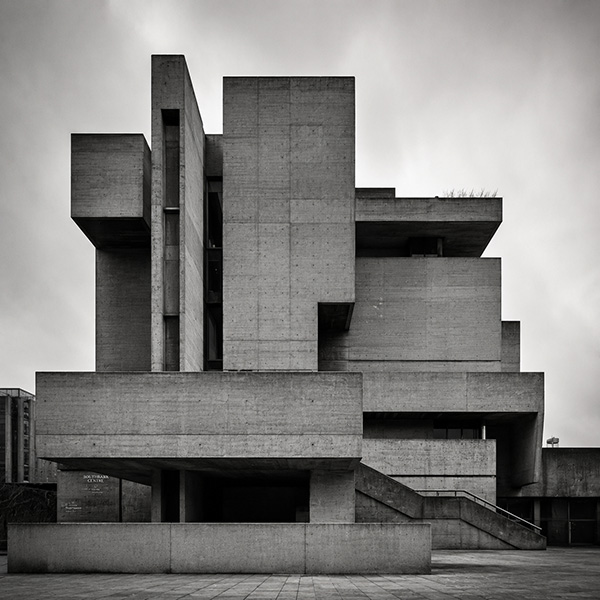
The history can be short. The name comes from béton brut — raw concrete — not from brutality. The movement grew out of post-war reconstruction, carried social ambitions, and refused ornament on principle: the structure itself was the language. Then fashion turned, the buildings were dismissed as concrete monsters, and many of them spent decades unloved. That is the part everyone knows.
The icons: Mäusebunker and St. Agnes
Two buildings carry Berlin’s Brutalism debate in public. The Mäusebunker in Lichterfelde — Gerd and Magdalena Hänska’s former research building — looks like a ship run aground: a grey wedge with blue ventilation pipes aimed at the street. For years the city argued about demolishing it; in 2023 it was listed as a monument instead. It is the rare building that became famous for being unloved. I keep a German field note on the Mäusebunker on my architecture site — and what it teaches from the outside is simple: concrete can carry colour after all. Those pipes are the loudest blue in the district.
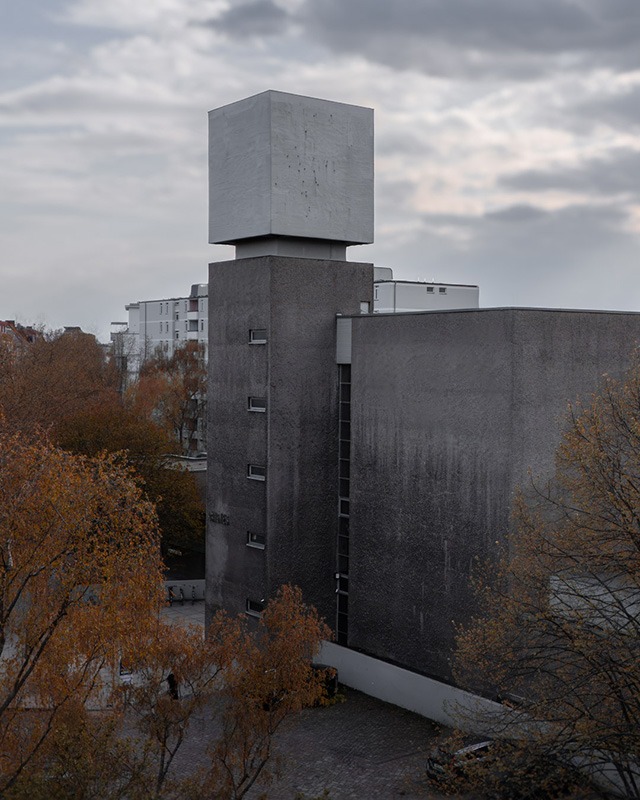
St. Agnes in Kreuzberg is the counter-example — Werner Düttmann’s church from 1967, a windowless concrete block that was deconsecrated and, since 2015, has held the König Galerie. Art moved into the building everyone had called inhuman, and its rooms turned out to be exactly what large work needs: mass, stillness, indirect light. When people ask whether Brutalism can age well, St. Agnes is the shortest answer I know. I have written a separate note on photographing St. Agnes from the street — its history, Brandlhuber’s slab, and why the trees on Alexandrinenstraße decide the picture.
Berlin’s concrete, without the icons
The icons are photographed constantly, and well. What interests me more is the concrete nobody defends: hospital wings, apartment blocks, the backs of buildings. Architecture that was never meant to be looked at for long, and therefore never learned to pose.
One of the pictures in Fremde Fassaden shows a wall of the Urban hospital in Kreuzberg — Peter Poelzig’s reinforced-concrete complex, inaugurated in 1970 as the first new municipal hospital of post-war Berlin. What stopped me was not the building’s biography. It was a run of blue-tinted ventilation pipes against the grey wall. The blue was already there; I only pushed it a little. That is the whole method in one sentence: the picture begins with something the building offers, and ends with a decision the building did not make.
Sun, shadow, and a different route
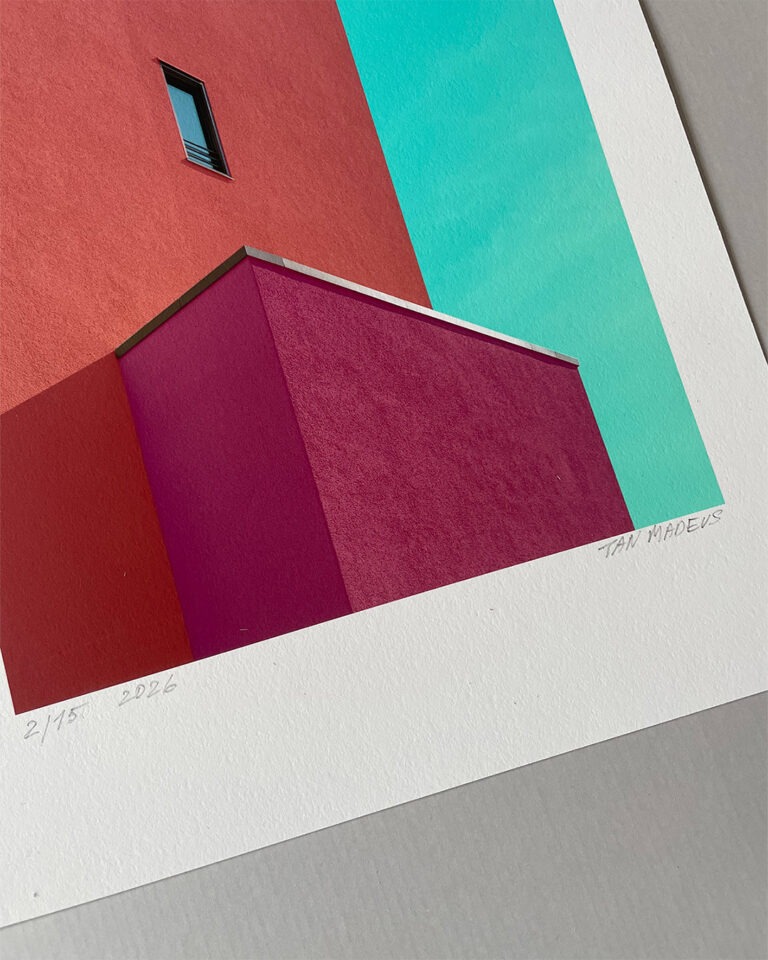
For these walls I want sun. Hard light is the grammar of concrete — it draws the edges, separates the planes, gives the mass its weight. The photographers who taught a generation to see Brutalism, Peter Chadwick and Simon Phipps among them, mostly worked towards black and white: geometry first, matter second — a route that runs back through the tradition I have traced in famous architecture photographers. I respect that route and take another. In Fremde Fassaden the colour is shifted afterwards — a decision, not a record. Concrete takes that decision better than any other material, because it never had a colour it insisted on.
Photographing brutalist architecture in Berlin
The light decides the picture more than the address does. Low sun rakes across ribbed concrete and draws its relief; an overcast sky flattens the same wall into a colour field. Both are usable — they make different pictures, and each of my series insists on one of them. As for addresses: the icons stand in Lichterfelde and Kreuzberg, the unlisted rest in almost any post-war estate between them, which is the better hunting ground — building by building, they are in my guide to brutalist buildings in Berlin worth photographing. And everything in this note is made from the public street. That is not a limitation — the street is where this architecture was meant to be seen, and in Germany the Panoramafreiheit covers what a camera sees from it.
Most of the pictures were made within walking distance of my flat, in Kreuzberg and Berlin-Mitte. Brutalism did not need rediscovering there. It needed looking at.
Common questions
What is brutalist architecture?
A post-war way of building named after béton brut — raw concrete — not after brutality. Structure and material stay visible and do the talking; ornament is refused on principle. Its reputation has swung from social ambition to “concrete monster” and, in recent years, part of the way back.
Where can you see brutalist architecture in Berlin?
The famous cases are the Mäusebunker in Lichterfelde and St. Agnes in Kreuzberg, today the König Galerie. The Urban hospital in Kreuzberg belongs on the list — and so does the everyday concrete of almost any post-war housing estate, the part nobody defends and I photograph.
Is the Mäusebunker protected?
Yes. After years of demolition debate it was listed as a monument in 2023, and the city has been working out a second use for it since. Like everything in this note, it can be photographed from the public street.