
Every list of famous architecture photographers tells you who mattered. Almost none tells you why — what each of them actually decided, standing in front of a building, that nobody had decided before. I photograph façades for a living, so that second question is the only one that interests me. The names that follow are the usual canon: Julius Shulman, Ezra Stoller, Lucien Hervé, Balthazar Korab, Bernd and Hilla Becher, Candida Höfer, Hélène Binet, Iwan Baan, Fernando Guerra, Hufton + Crow, Simone Bossi, Rasmus Hjortshøj. What I can add is a working photographer’s reading of them — twelve different answers to the same question: what is a building, once you point a camera at it?
The twelve architectural photographers at a glance
| Photographer | Years | Known for |
|---|---|---|
| Julius Shulman | 1910–2009 | Case Study House #22 (Stahl House, Pierre Koenig), Los Angeles, 1960 |
| Ezra Stoller | 1915–2004 | Fallingwater (Frank Lloyd Wright), Seagram Building (Mies van der Rohe) |
| Lucien Hervé | 1910–2007 | Le Corbusier’s photographer, 1949–65; Unité d’Habitation, Marseille |
| Balthazar Korab | 1926–2013 | Eero Saarinen’s photographer; TWA Flight Center, New York |
| Bernd & Hilla Becher | 1931–2007 / 1934–2015 | Typologies of water towers and blast furnaces; the Düsseldorf School |
| Candida Höfer | b. 1944 | Empty public interiors — libraries, theatres, the Louvre |
| Hélène Binet | b. 1959 | Zaha Hadid, Daniel Libeskind; black-and-white film |
| Iwan Baan | b. 1975 | Rem Koolhaas; Torre David, Caracas (Golden Lion 2012) |
| Fernando Guerra | b. 1970 | Álvaro Siza and contemporary Portuguese architecture |
| Hufton + Crow | studio, UK | Zaha Hadid’s Heydar Aliyev Center, Baku |
| Simone Bossi | Italian | Quiet contemporary houses in Italy |
| Rasmus Hjortshøj | Danish | BIG, Henning Larsen; studio COAST, Copenhagen |
The modernists’ witnesses
Julius Shulman
Shulman photographed the Californian modernists — Neutra, Koenig, the Case Study Houses — and understood earlier than anyone that a building becomes desirable when you photograph the life it promises, not the structure it is. His picture of two women in a glass house floating above the lights of Los Angeles is probably the most reproduced architectural photograph ever made. What I take from him: a photograph of a building is always an argument, never a record. Shulman argued for a way of living. You have to know what you are arguing for.
Ezra Stoller
On the East Coast, Stoller did for Saarinen, Mies and Wright what Shulman did in California — so reliably that architects began saying a building wasn’t finished until it had been “Stollerized”. His pictures are patient, exact, and completely unsentimental: the building’s own geometry, in the building’s own best light. From Stoller I take the discipline of waiting. He would return until the light did what the architecture needed. That is not a technique. It is a relationship to time.
Lucien Hervé
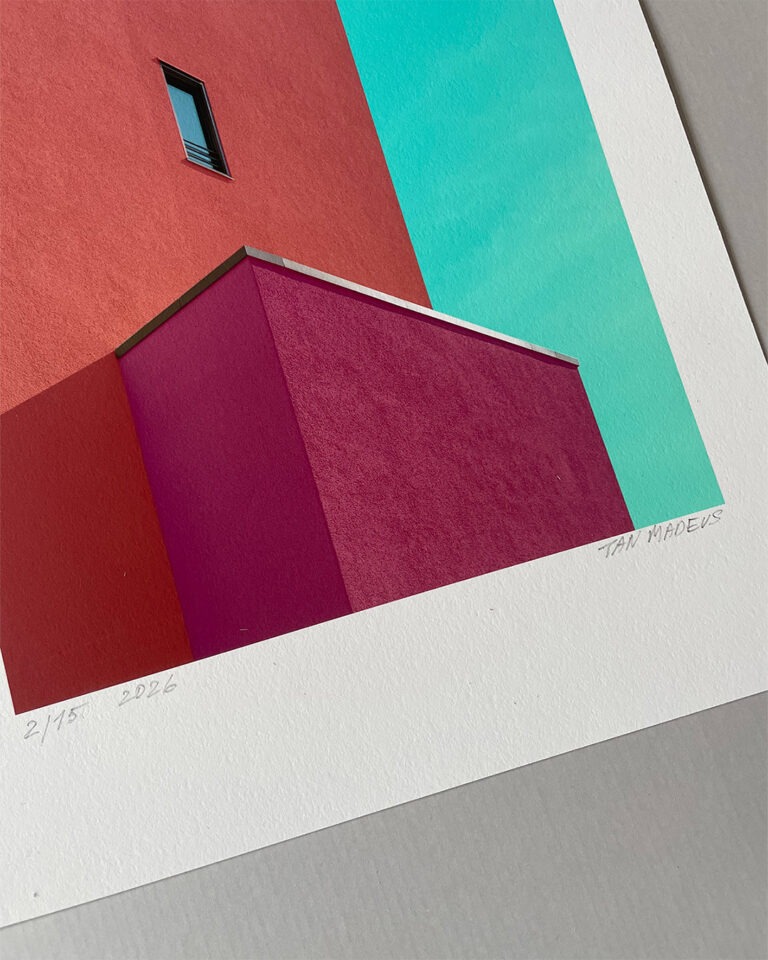
Hervé was Le Corbusier’s photographer, and the most painterly of the modernist witnesses. He cut buildings into fragments — a stair, a shadow, a slab of raw concrete — and let the shadow carry more weight than the wall that cast it. His Chandigarh pictures read as abstract compositions first and architecture second. Of everyone on this list, he is the one I feel closest to: the conviction that a fragment of a building can hold more truth than the whole of it runs directly into my own Fremde Fassaden.
Balthazar Korab
Korab trained as an architect and worked in Saarinen’s office before he photographed for it, and it shows: he photographed buildings the way architects think about them — as things under construction, in weather, in doubt. His construction photographs of the TWA Terminal are as alive as the finished shell. From Korab: the building before completion, and the building in bad weather, are both still the building. Sometimes they are the better picture.
The Düsseldorf lesson
Bernd and Hilla Becher
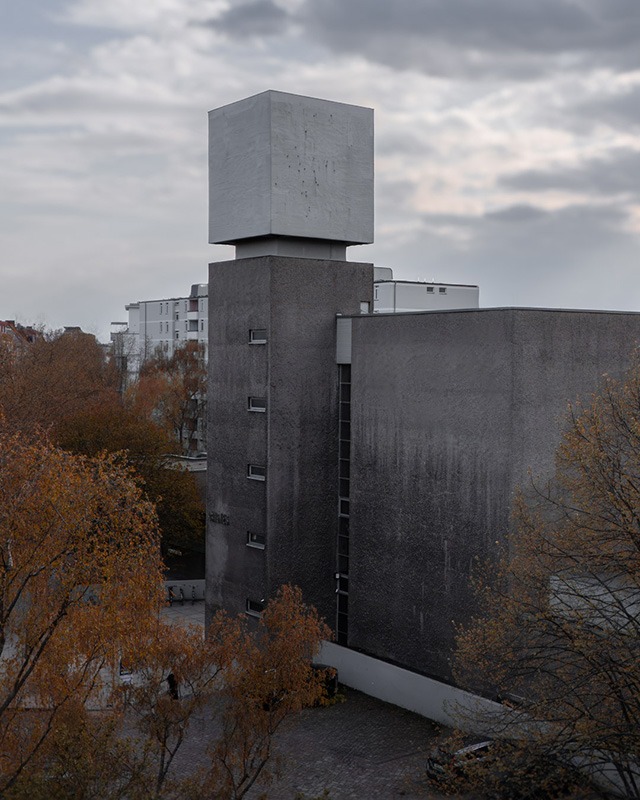
The Bechers photographed water towers, blast furnaces and winding towers for decades — frontal, centred, under grey skies, printed as grids of near-identical frames. They called the results typologies, and the art world eventually agreed that this was sculpture by photographic means. Their teaching in Düsseldorf shaped a whole generation — Gursky, Struth, Ruff, Höfer. From the Bechers I take the most important permission in my working life: repetition is not poverty of imagination. Photograph the same kind of thing again and again, under the same flat light, and the differences begin to speak. My series Das Haus gegenüber — one apartment block, one framing, many months — would not exist without them.
Candida Höfer
Höfer photographs interiors — libraries, theatres, museums — empty of people and rigorously symmetrical, in the light the room itself provides. The absence of people is the point: the room stops being a stage for something and becomes the subject. I photograph exteriors, but the rule transfers exactly. No people, no sky, no anecdote — remove everything that lets the viewer escape the surface, and the surface has to carry the picture alone.
Light as the subject
Hélène Binet
Binet works in analogue black and white and photographs buildings — Zumthor, Hadid, Libeskind — as encounters between light and matter. She is open about her suspicion of digital abundance: a limited number of frames forces the decision back to the moment of standing there. Her pictures are fragments, almost never overviews. What I take from Binet is the seriousness about light as material. In my colour work the light that crosses a façade — rather than illuminates it — is the whole event. Binet is the proof that this attention can sustain a life’s work.
The building in use
Iwan Baan
Baan turned the genre inside out: he photographs buildings the way a documentary photographer covers a story — full of people, traffic, laundry, weather, often from a helicopter, always in context. His pictures of informal architecture showed that inhabitation itself can be the architectural subject. I work at the opposite pole — my façades are deliberately empty — but Baan keeps me honest. Every exclusion in a photograph is a choice, and his work is the standing reminder of everything I choose to leave out.
Fernando Guerra
Guerra, based in Lisbon and working with his brother Sérgio under the studio name FG+SG, became the eye through which the world reads Portuguese architecture — Siza, Souto de Moura, and a generation after them. His pictures are warm, inhabited and full of southern light, closer to reportage than to still life. From Guerra: fluency. He shoots fast, moves through a building like a visitor rather than a surveyor, and trusts the moment. It is the opposite of my temperament, which is exactly why it is worth studying.
Hufton + Crow
Nick Hufton and Allan Crow photograph the large signature buildings of our moment — Hadid, Heatherwick and their peers — with a polish that has become the default visual language of contemporary architecture publishing. Their skill is orchestration: crowds, dusk, reflections, all resolved into a single composed frame. I take from them a sober lesson about the market: this is what commissioned architectural photography at the highest level looks like. Knowing the convention precisely is what lets you depart from it deliberately.
The quiet contemporaries
Simone Bossi
Bossi, an Italian photographer with an architectural background, is the strongest current voice of the quiet school: muted colour, soft light, few or no people, an interest in atmosphere over information. His pictures feel held rather than taken. He matters to me because he proves there is an audience — architects, editors, collectors — for restraint. The loud picture wins the scroll; the quiet one gets printed and lived with.
Rasmus Hjortshøj
Hjortshøj photographs from Copenhagen, much of it around water — harbours, coasts, and the Danish architecture that engages them. Trained in architecture himself, he moves easily between the commissioned picture and long-form personal projects about how buildings sit in landscape. From him I take the value of the long project: a body of photographs about a place accumulates a weight that no single commission reaches.
What the whole list teaches
Read together, these twelve are not one tradition but two. One line — Shulman, Stoller, Guerra, Hufton + Crow — serves architecture: the building is the client, and the photograph argues on its behalf. The other line — Hervé, the Bechers, Höfer, Binet — uses architecture: the building is raw material for a picture that answers to nothing but itself. Both lines are honourable. But you have to know which one you are standing in. My own work stands in the second: I photograph architecture as abstraction — frontal, unpeopled, colour-shifted — and the pictures are made for walls, not for portfolios. How that came out of a painter’s training is a longer story.
Common questions
Who is the most famous architecture photographer?
By reproduction and name recognition, Julius Shulman — his Case Study House picture over Los Angeles is the genre’s one universally known image. Among architects themselves, Ezra Stoller and, today, Iwan Baan are probably cited more often.
What separates fine art architecture photography from commissioned work?
The client. Commissioned photography answers to the building and the architect; fine art photography answers to the picture. In practice the difference shows in what gets excluded — people, sky, context — and in where the work ends up: publications on one side, editioned prints on the other.
Which of these photographers work in colour?
Shulman, Stoller and Korab worked in both but are remembered largely for black and white; Hervé and Binet are black and white by conviction; the Bechers grey by principle. Höfer, Baan, Guerra, Hufton + Crow, Bossi and Hjortshøj work in colour — as do I, though mine is shifted rather than found.