St. Agnes in Berlin-Kreuzberg is the building people bring up when they want to prove that Brutalism can be loved after all. A windowless church that lost its congregation, stood empty, and came back as the KÖNIG GALERIE. I have photographed it from the street more than once, and I keep going back for a reason that has little to do with the story. The story is good. The surface is better.

A church built as a block
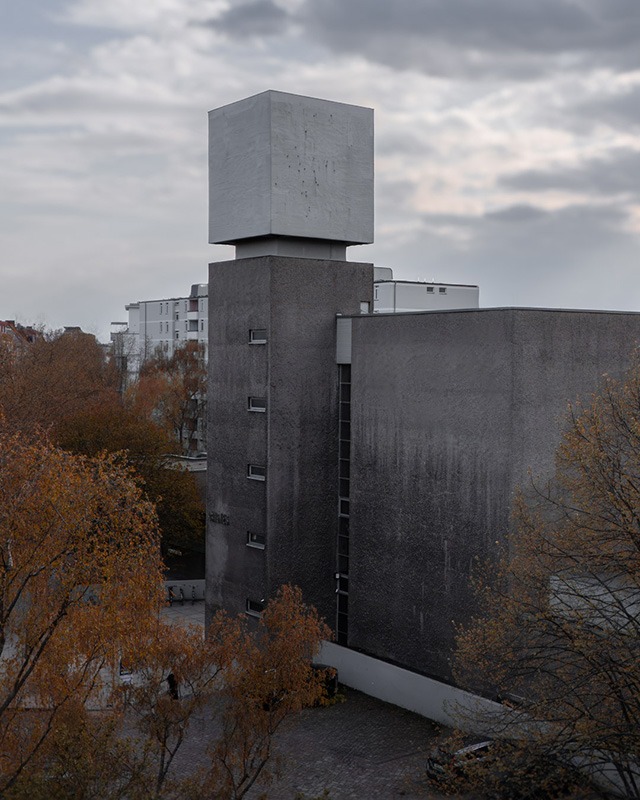
Werner Düttmann designed St. Agnes between 1964 and 1967, at the end of his time as West Berlin’s Senatsbaudirektor. The same years gave the city the Brücke-Museum in Dahlem; a few years earlier he had built the Akademie der Künste on Hanseatenweg. St. Agnes is the harshest of the three. The church is a closed cube with no windows in its walls, a freestanding bell tower beside it, and a courtyard behind it ringed by the parish house, the hall and a kindergarten — a small, inward-looking settlement of grey buildings on a corner in Kreuzberg.
One correction to what is usually written about it: the walls are not exposed concrete. The structure is a concrete frame, but the outside is a rough, sprayed cement render, grey and grainy, closer to sandpaper than to poured stone. That matters if you photograph it. Concrete holds shadow in its pores and formwork lines; sprayed render holds shadow everywhere at once. Under a low sun it turns into a field of tiny points of light and dark — a texture rather than a material.
The congregation left in 2004. A free church used the building for a few years; the monument listing came in 2008. Johann König took it over at the end of 2011, on a long lease, and Arno Brandlhuber’s office rebuilt the interior. The move was simple and radical: a concrete slab on twenty square columns was set into the nave at the height of the old organ loft, touching the old walls nowhere — a table inside a box. Above the slab the gallery has a hall about 28 metres long and 10 metres high; below it, the lower rooms. The gallery opened in May 2015 and won the Architekturpreis Berlin the year after.
Inside: a room that was always a gallery

What surprised me inside is how little was needed. Düttmann had already built a room for looking: no windows at eye height, light from a band in the ceiling and two tall slots, walls that give the eye nothing to hold on to except what is hung on them. A church wants you to look up and forward. So does a gallery. The slab changed the proportions and left the logic alone. A small picture on that wall reads from thirty metres away, because the wall itself has no scale — it is the same grain from floor to ceiling.
I photographed the hall during an exhibition, with the works deliberately kept small in the frame. The room is the subject here, not what hangs in it. If you go, the gallery is open Tuesday to Sunday; the courtyard and the tower are visible from the street at any time.
Photographing St. Agnes from the street
You can only photograph the church from Alexandrinenstraße. That is the first thing to know, and the second is that Alexandrinenstraße is lined with trees, and the pavement is close to the wall. There is no standpoint from which the whole building sits in the frame without a branch across it. I tried, several times, and stopped trying. The picture of St. Agnes as a complete object belongs to the drawings and to the archive photographs from 1967, when the trees were saplings. From the street today you get parts: the tower, a corner, the render, a slice of the cube against sky.
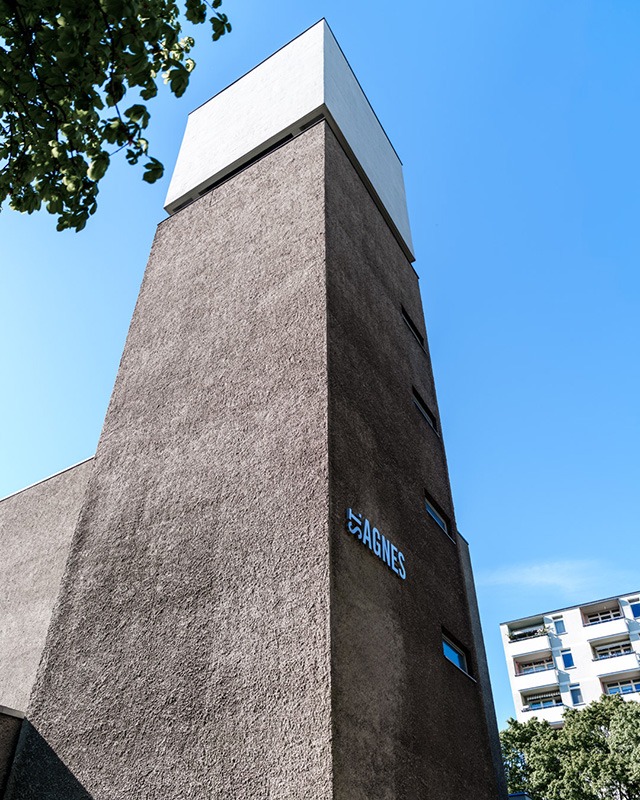
Go in the morning. The light comes in from the side then, and side light is what this render needs — it gives the surface its grain and separates the tower from the cube behind it. In the afternoon the sun stands behind the building and you are photographing into it; the walls go flat and dark, the sky burns out, and the tower’s white top becomes the only thing in the picture. That can be a picture too, but it is a different one, and it is harder.
Overcast days are the third option, and the one I used for the photograph at the top of this note. Without sun the render stops being a texture and becomes a tone: one grey plane, the same value from bottom to top. That is when the building comes closest to how Düttmann drew it — as mass, not as surface.
Why it is not in the series yet
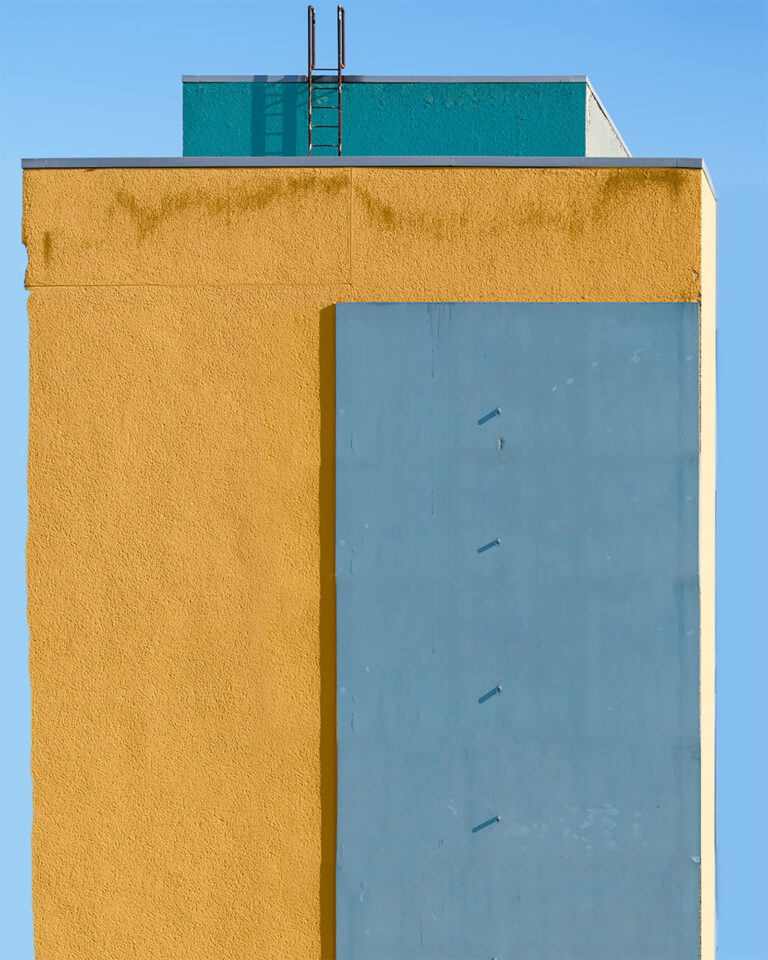
The pictures on this page are notes. None of them is a work from Fremde Fassaden, and the reason says something about the series. In Fremde Fassaden I photograph a wall head-on, crop the building away, and shift the colour afterwards — a decision, not a record. The Urban hospital, a few streets away, gave me that picture at once: a grey wall and a run of blue pipes, and the blue was already there, I only pushed it. St. Agnes has not given me its picture yet. Its wall is all texture and no colour, and the trees keep me from standing where I would need to stand. It is the building in Kreuzberg I have photographed most and used least.
I suspect the work, when it comes, will be a detail: a metre of render, a shadow edge, the seam where the tower meets the sky. Something that could be any wall, until the colour tells you it is not.
Visiting St. Agnes in Berlin
Address: Alexandrinenstraße 118–121, 10969 Berlin-Kreuzberg.
Inside: KÖNIG GALERIE, Tuesday to Sunday, 11:00–18:00. Hours change during installations — check the gallery before you go.
Outside: tower, nave and courtyard are visible from Alexandrinenstraße at any time.
Light: morning for side light on the render, overcast for a flat grey plane; the afternoon is backlight.
Common questions
Who designed St. Agnes in Berlin?
Werner Düttmann, then West Berlin’s Senatsbaudirektor, built the church between 1964 and 1967. He also designed the Akademie der Künste on Hanseatenweg and the Brücke-Museum in Dahlem.
Is St. Agnes still a church?
No. It was deconsecrated in 2004/05, listed as a monument in 2008, and has housed the KÖNIG GALERIE since May 2015. Arno Brandlhuber’s office set a concrete slab on twenty columns into the nave, turning one tall space into two galleries.
Can you photograph St. Agnes?
From Alexandrinenstraße, yes — the street is public and German Panoramafreiheit covers what a camera sees from it. Morning light is best; the trees make a full view of the building impossible. Inside, the gallery decides; I photographed the hall with the works kept small in the frame.